Who's Actually Buried in Boston's Haunted Graveyards
The Boston ghost tour visits Granary and Copp's Hill Burying Grounds. Here's who's really buried there — three Declaration signers, the Boston Massacre victims, and a headstone the British used for target practice.
The Boston Ghosts & Gravestones tour stops at two of the oldest burial grounds in America. That’s the part worth understanding before you go: these aren’t set-dressing for a ghost story. They’re real colonial cemeteries where the people who started a revolution are buried, a few feet from where you’ll be standing after dark.
Here’s who’s actually down there.
Granary Burying Ground: the founders’ cemetery
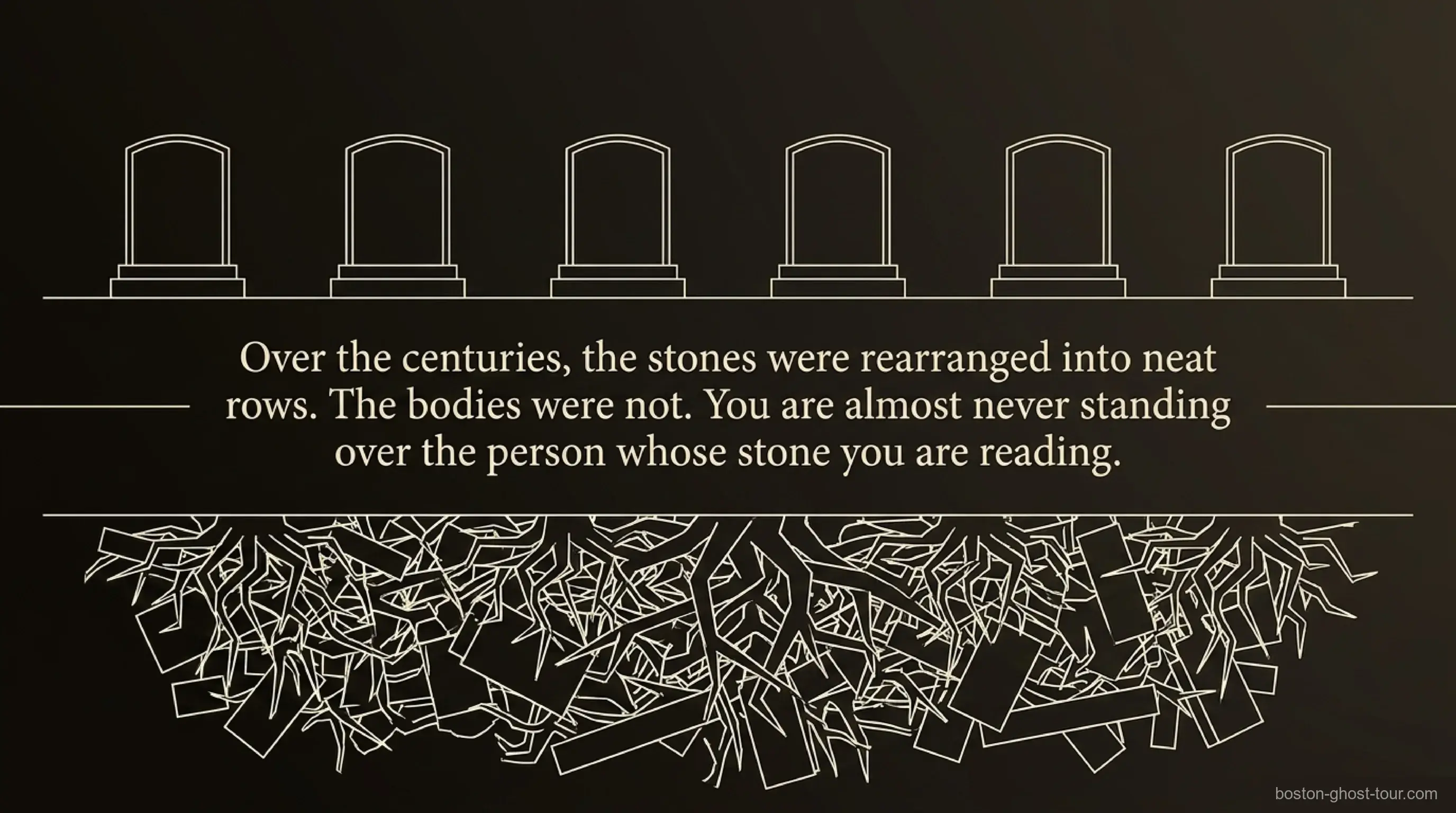
Granary opened in 1660 and holds an estimated 5,000 people under roughly 2,300 surviving grave-markers — the count doesn’t match because centuries of stones have been lost, moved, or rearranged into the tidy rows you see today. The bodies were never rearranged to match. You are almost never standing over the person whose stone you’re reading.
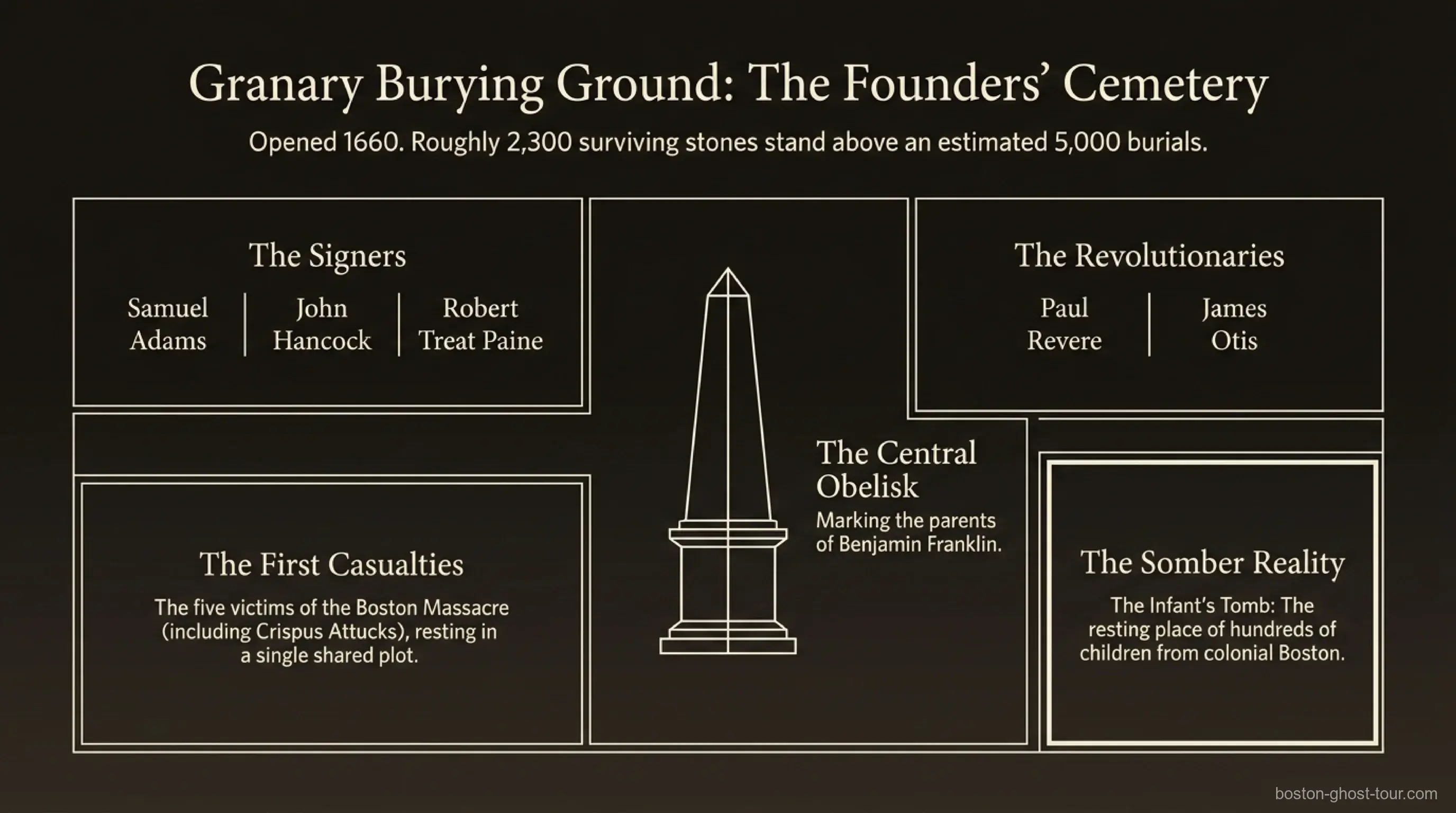
Three signers of the Declaration of Independence are buried here:
- Samuel Adams — the agitator, the one who kept the revolution lit when it might have gone out
- John Hancock — the enormous signature, the first governor of Massachusetts
- Robert Treat Paine — the third and least famous of the three, Massachusetts’s first attorney general
And beside them, the rest of the revolutionary generation:
- Paul Revere, whose midnight ride you already know — his stone is smaller and plainer than most visitors expect
- The five victims of the Boston Massacre, including Crispus Attucks, buried together in a single plot — the first casualties of the coming war, killed in 1770
- James Otis, who argued against the writs of assistance and gave the movement one of its early rallying cries
- The parents of Benjamin Franklin, marked by the central obelisk — Franklin himself is in Philadelphia
There’s a genuinely somber corner too: the Infant’s Tomb, near that central obelisk, where hundreds of children were interred. Colonial Boston buried a lot of children.
Copp’s Hill: the one the British shot at
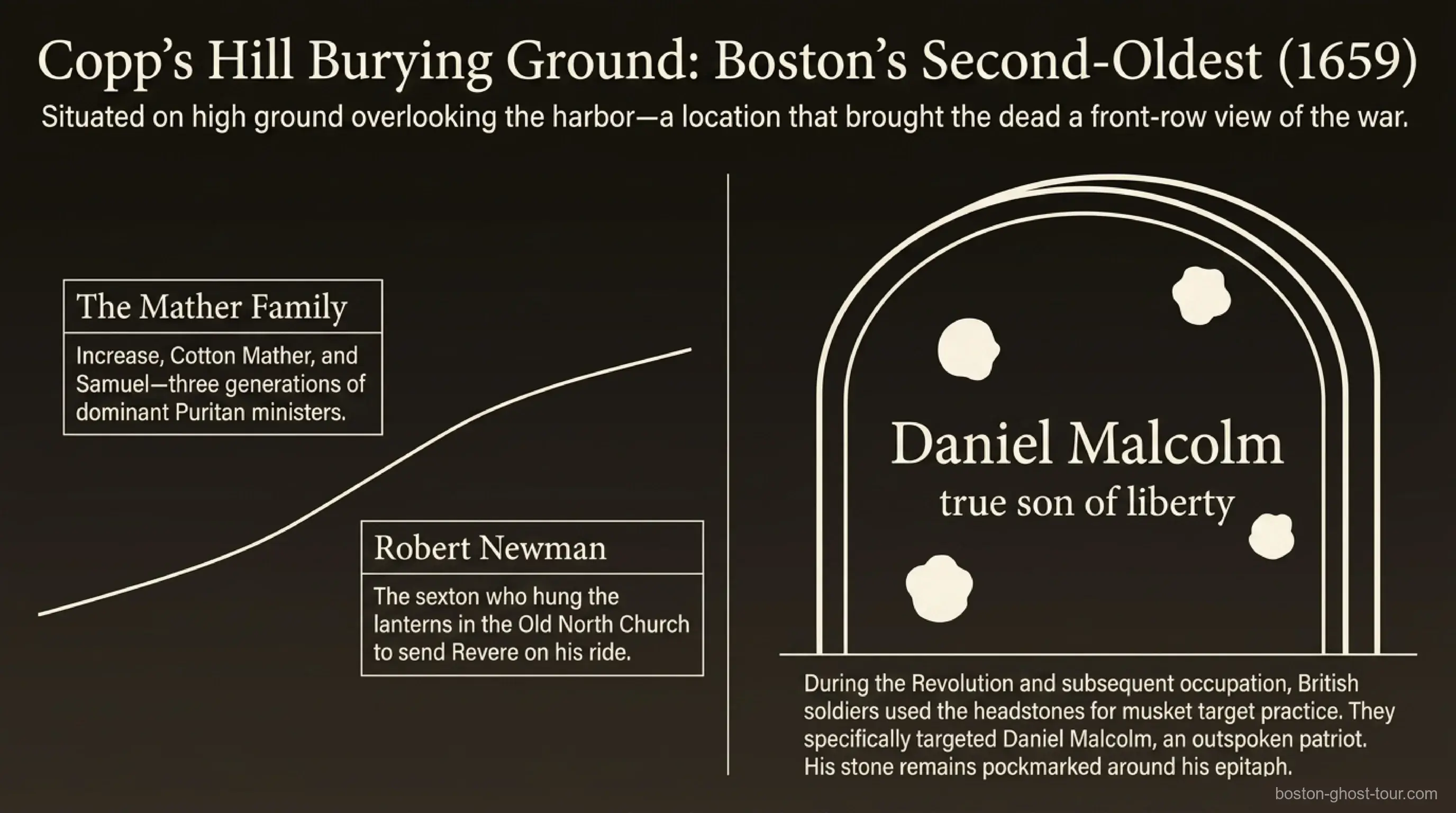
Cross town to the North End and Copp’s Hill Burying Ground, Boston’s second-oldest, dating to 1659. It sits on high ground overlooking the harbor, and that location is the whole story.
Buried here:
- The Mather family — Increase, Cotton, and Samuel, three generations of the Puritan ministers who dominated New England’s religious life. Cotton Mather is the name most people recognise: he was deeply entangled in the intellectual climate that produced the Salem witch trials.
- Robert Newman, the sexton of the Old North Church, who climbed the steeple and hung the two lanterns — “one if by land, two if by sea” — that sent Revere on his ride. He’s buried a short walk from the church tower he lit.
And the detail that makes Copp’s Hill different from any other cemetery on the tour: the gravestones carry musket damage. During the occupation of Boston, British soldiers used the headstones for target practice. They singled out one stone in particular — Daniel Malcolm, a merchant and outspoken patriot who died in 1769. His epitaph called him “a true son of liberty… an enemy to oppression,” and the pockmarks around the lettering are still visible. The soldiers were shooting at the words.
From this same hill, the British sited a battery and directed the shelling of Charlestown during the Battle of Bunker Hill. The dead had a front-row view of the war they’d started.
Why the graveyards, and why at night
A daytime Freedom Trail walk passes both of these burial grounds and tells you the patriotic version — the founders, the signatures, the ride. The ghost tour covers the same ground after dark and tells you the rest: the epidemics, the buried children, the shot-at stones, the fact that the neat rows are a lie and the bodies are still where they fell.
Both are true. The night version is just the one that admits these were places of mass death long before they were monuments.
If you’d rather have the revolutionary history in daylight, or you’re weighing a Salem day trip instead, the comparison on the homepage lays out all three side by side.
Before you go
- Wear real shoes. These are 350-year-old uneven grounds, walked in the dark.
- The stones you read aren’t the graves you’re standing on. The markers were rearranged; the dead weren’t.
- Look for the musket marks on Copp’s Hill. Daniel Malcolm’s stone is the one to find.
- It’s a burial ground, not a haunted house. The tour leans into atmosphere, but real people are buried here — the good ones treat that with a straight face.
Historical details verified against the National Park Service, the Freedom Trail Foundation, and the City of Boston cemetery records, July 2026.
Ready to Book Your Boston Ghost Tour?
Browse haunted walking tours and evening experiences in Boston — free cancellation, from $13 per person.
Browse Boston Ghost Tours